
Sealand Technology and Shanghai Maritime University Host Landmark Summit on Marine Biofouling
SHANGHAI, China – In a significant industry event demonstrating the power of academic and corporate collaboration, Sealand Technology, a leader in marine robotics, recently hosted the "Advanced Training Program on Ship Biofouling Management" at the prestigious Shanghai Maritime University. From September 22-26, the summit convened 20 senior maritime officials from Cambodia, Malaysia, Vietnam, Laos, Thailand, and China to address one of the industry’s most pressing environmental and economic challenges.
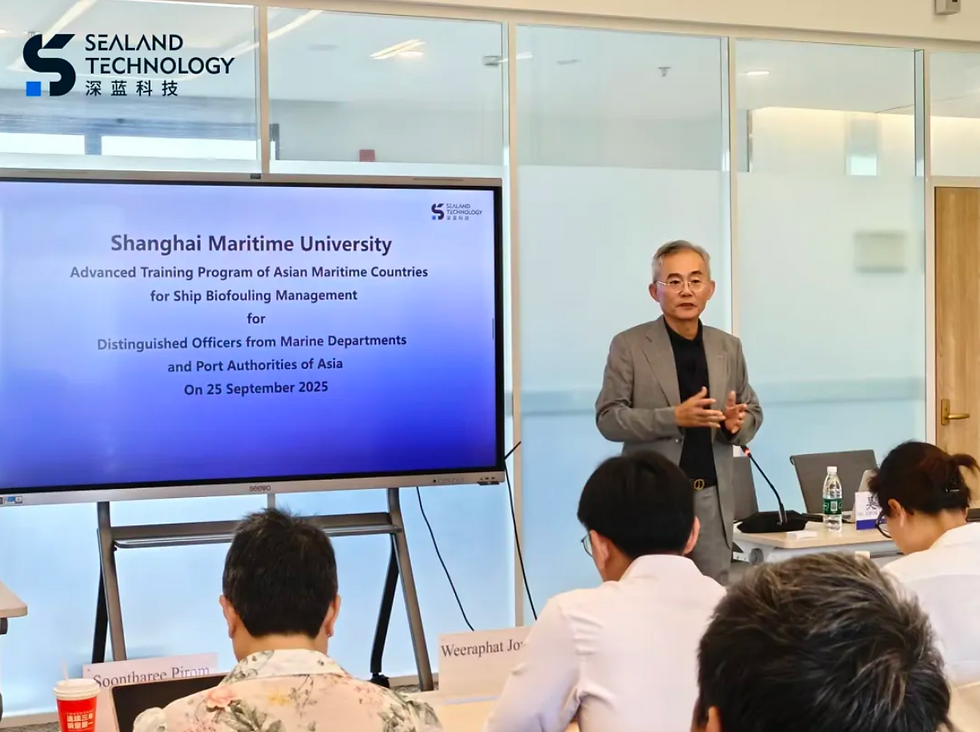
The event, framed as a crucial knowledge-sharing platform, showcased Sealand Technology’s cutting-edge underwater robotics, with the university providing the academic authority and venue for this high-level industrial dialogue.
A Masterclass in Marine Robotics
The highlight of the summit was a compelling training session led by Shareholder and Senior Consultant, Andrew Ng, who also serves as the Chief of Marine Engineering for the Greater Bay Area Yacht and Cruise Industry Association (GBAYCIA). Ng translated complex engineering concepts into accessible insights for the international delegation, using the analogy of underwater robots as "underwater doctors" performing precision check-ups on a ship's hull.
"Marine environmental protection knows no borders," Andrew Ng stated during the training. "We are eager to share our technological achievements and experiences in managing ship biofouling with countries across Asia. Through technological cooperation, we can jointly protect our shared blue oceans."
During a lively interactive session, Andrew addressed specific regional challenges, from tackling organisms unique to tropical waters for Thai officials to discussing the feasibility of robotic solutions in smaller Malaysian ports. His ability to provide customized, practical advice underscored the adaptability of the technology and the depth of expertise driving the collaboration.
The Global Challenge of Ship Biofouling
Ship biofouling—the accumulation of marine organisms on a vessel's hull—poses a dual threat to the maritime industry. Research indicates that heavy biofouling can increase a vessel's fuel consumption by up to 40%, translating to millions of dollars in additional operating costs and significantly higher carbon emissions for the global shipping fleet.
Beyond economics, biofouling facilitates the transfer of invasive species across ecosystems, endangering marine biodiversity and disrupting local marine environments. The International Maritime Organization estimates that biofouling is responsible for the majority of marine bio-invasions worldwide. As Asian nations work to strengthen their maritime economies while meeting environmental commitments, finding sustainable solutions to this problem has become a shared priority, making industry-led events like this essential.

International Acclaim and a New Model for Collaboration
The training was met with high praise. Vietnamese officials noted the maturity of Chinese underwater robotics in intelligent identification and precise cleaning, while representatives from Laos, a landlocked nation, found value in the technology for managing biofouling in the Mekong River Basin.
This event marks a newsworthy model for industry advancement: a leading technology firm (Sealand) partnering with a top academic institution (Shanghai Maritime University) to upskill government decision-makers from across the continent. The participation of experts like Andrew Ng, with his dual role at Sealand and GBAYCIA, further highlights the interconnected nature of the modern maritime ecosystem.
By bringing together industry, academia, and government, this summit has not only advanced the dialogue on sustainable maritime practices but has also set a new standard for technological diplomacy and regional cooperation in Asia.

Become Part of GBAYCIA's Global Network
GBAYCIA is building bridges across Asia's maritime industry. If you're passionate about marine technology, sustainable shipping, or regional collaboration, we want to hear from you.
📧 Email us: info@gbaycia.org
🌐 Visit: www.gbaycia.org
Let's shape the future of the Greater Bay Area's yacht and cruise industry together.



Comments