
Jiangmen Yacht Industry: A Factory Base Is Not Yet a Yacht Economy
Updated: Sep 9
A yacht earns build revenue once. The same hull can generate berth fees, haul-outs, warranty work, crew services, fuel sales and visitor spending for years.
That lifecycle distinction was the real commercial question behind the yacht-industry exchange held in Jiangmen’s Silver Lake Bay Coastal New Area on 2 September 2026. Manufacturers, equipment suppliers, tourism operators and industry associations inspected local sites and discussed how Jiangmen could convert an established production base into recurring marine business.
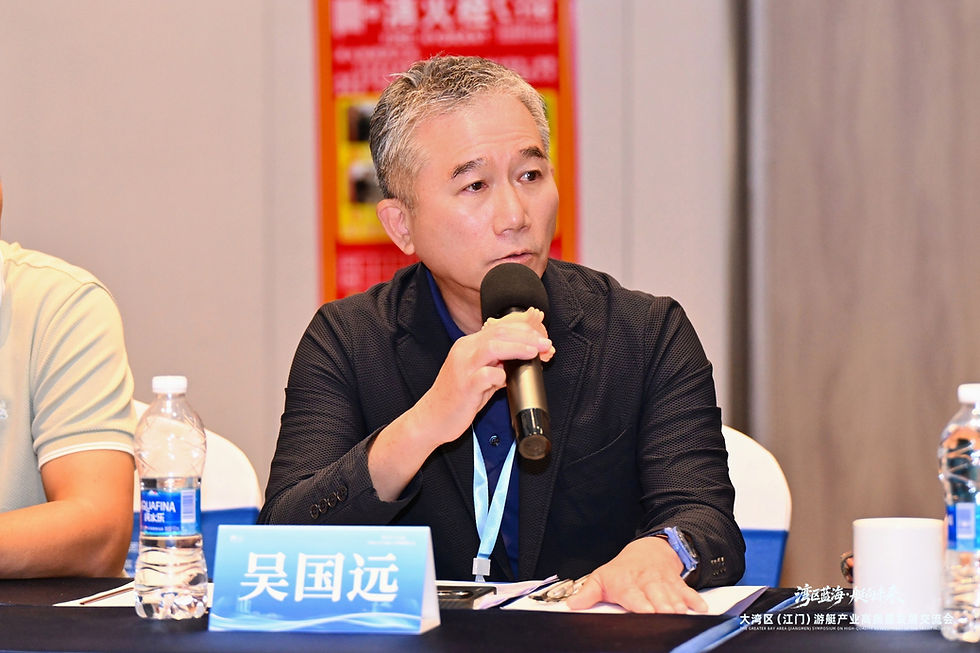
GBAYCIA Chairman and Co-Founder Ricky Ng and Captain Joe Tsang both participated and spoke. Public reporting records Ricky’s proposal for phased, asset-light development around smaller yachts, water tourism and Hong Kong cooperation; GBAYCIA has not attributed a specific position to Captain Joe because no public transcript reviewed for this article records his remarks.
The event supplied the evidence. The larger question is GBAYCIA’s: where should Jiangmen sit in the Greater Bay Area’s yacht operating chain?
The Jiangmen Yacht Industry Starts with a Real Builder’s Yard
Jiangmen is not starting with a marina rendering and a land-sale brochure. The city already has a vessel-manufacturing base, including established builders such as Heysea Yachts and Selene Yachts, within a wider Guangdong cluster for small and medium-sized craft.
Heysea’s current product range covers superyachts, bespoke motor yachts and panoramic models. In May 2026, the company announced a European order for a 35-metre aluminium explorer yacht—useful evidence that Jiangmen yards can compete for complex, export-facing work.
The geography is substantial as well: Jiangmen records 4,880.47 square kilometres of sea area, 409 kilometres of mainland coastline and 352 islands. Those figures describe cruising potential, not operating capacity. They do not tell an owner the controlling draught at a berth, the maximum LOA alongside, the availability of shore power or whether a launch can clear in and out on a Saturday.
That is the distinction between maritime geography and a yacht market. Water is the raw material; access and service are the product.

Repair Access Is More Valuable Than Another Waterfront Rendering
Jiangmen’s strongest near-term advantage may already be operational. In June 2025, the city launched a direct-entry arrangement for eligible Hong Kong- and Macau-registered vessels entering Jiangmen for repair, becoming the third Guangdong city reported to offer the route after Zhongshan and Guangzhou.
The first published case involved the Hong Kong-registered Guohui, which arrived at Xinhui Tianma Port on 19 June 2025 for work at Jiangmen Yamen Shipbuilding. Jiangmen’s official account estimated that direct entry could save approximately RMB100,000 per call compared with tug-assisted entry.
For an owner or fleet manager, that is not an abstract policy gain. It can reduce mobilisation cost before the yard period even begins.
The commercial opportunity is to turn that entry channel into a dependable service proposition: a clear pre-arrival document list, known port and customs procedures, an identified service berth, agreed scope of work, class or survey requirements where applicable, parts logistics, sea-trial arrangements and a named departure process. The official case confirms that the route exists; each vessel, yard and work package still requires individual clearance.
A repair corridor becomes a market only when the captain can plan it before slipping lines.
Why the Sub-12-Metre Market Changes the Operating Model
The strongest discussion in Jiangmen was not about building ever-larger yachts. It was about widening the customer base.
Ricky Ng proposed a staged approach centred on smaller yachts, yacht tourism, cross-city water routes and cooperation with Hong Kong industry organisations. Heysea Chairman Leng Xuehua made the complementary commercial point: superyachts can establish a builder’s brand, but greater domestic participation will require a market below 12 metres.
That segment is not a superyacht marina reduced in scale. It needs a different operating stack: launch ramps, trailer access, dry-stack or economical storage, chandlery, engine service, training, weather information and straightforward insurance. The customer may want a half-day fishing run or family coastal trip, not a permanent wet berth and a full-time crew.
Li Zhushen’s proposal to connect fishing ports and shore-side stopping points therefore matters. A network of modest, properly specified landing places may produce more real boating activity than one prestige basin—provided each point publishes approach limits, depths, operating hours, passenger arrangements and emergency contacts.
This is where Jiangmen can avoid an expensive category error: do not design small-craft participation around superyacht infrastructure costs.

Silver Lake Bay Must Connect Production with Vessel Use
Official event reporting says Jiangmen is planning a yacht-industry city around Silver Lake Bay, with research, intelligent manufacturing, exhibitions, final assembly, components, maintenance and coastal tourism in the proposed mix. The concept is broad; the reviewed public sources do not yet establish a complete approved masterplan, capital programme, construction schedule or operating date.
The right question is not how many functions can be printed on the plan. It is whether the facilities connect in the order a vessel actually needs them.
A useful industrial waterfront requires navigable approach depth, a berth suitable for the vessel’s LOA and draught, lifting or haul-out capability matched to displacement, hardstanding, utilities, controlled contractor access and a supply chain that can deliver approved parts. If a yacht is expected to stay after handover, the owner also needs somewhere to berth, provision, bunker, change crew and start the next passage.
Jiangmen has also referred publicly to a first batch of mapped stopping points and a boutique route associated with Blue Sea Heart Journey. Current booking channels, timetables, passenger conditions, prices and port calls were not confirmed in the material reviewed; nor was an operating marina or public-berth specification established for Yangguanshan.
That is not a reason to dismiss the plan. It is a reason to publish the navigation and operating data that turns a point on a map into a usable call.

Free Travel Opens the Passage—Not the Charter Market
The Guangdong Hong Kong–Macau Yacht Free-Travel Management Measures took effect on 16 June 2026. They allow eligible Hong Kong and Macau private recreational yachts to enter through designated ports and move within the nine Mainland GBA cities, including Jiangmen, subject to temporary documentation, reporting, club management, safety and other requirements.
For Jiangmen, this creates an arrival channel for qualifying private vessels. It does not create a commercial-charter licence: an admitted yacht cannot be rented, transferred, sold or used for commercial water transport in Mainland waters.
The difference matters. A private owner arriving for repair, cruising or an organised visit sits inside one operating framework; a paying passenger excursion requires a separately lawful vessel, operator, licence, insurance and passenger-safety regime.
GBAYCIA has documented the distinction through the Free Travel inaugural voyage to Nansha and the first Hong Kong yacht voyage to downtown Guangzhou. Port access is progress. It is not permission to improvise the vessel’s commercial use.
The Jiangmen Yacht Industry Has a Distinct GBA Role
Jiangmen does not need to out-Hong Kong Hong Kong or reproduce the marina proposition of Shenzhen or Zhuhai. Its credible role is different: western-GBA build capacity, direct-entry repair, small-craft participation and coastal service infrastructure.
That role can support several revenue layers. A newbuild produces design, fabrication and commissioning work. The same vessel can later return for warranty rectification, haul-out, coatings, machinery service, electronics, class-related work, spares and crew support. Smaller local craft add storage, training, maintenance and repeat leisure use.
The Guangdong yacht action plan for 2024–2027 sets province-wide targets of at least 2,500 berths and stopping points, 4,000 registered yachts and more than RMB100 billion in yacht and associated industry scale by 2027. These are policy targets, not Jiangmen’s current output, but they show why a city with yard capability should think beyond unit sales.
The comparison with Sydney Harbour’s waterfront economy is useful for the same reason. The value is not the view from the quay; it is the turnover created when vessel access, marine services and time ashore reinforce one another.
What Jiangmen Should Put on the Next Berth Plan
The next useful document is not another broad investment deck. It is a vessel-facing operating brief for each repair route, stopping point and proposed visitor route.
Operating item | What an owner, captain or operator needs to know |
Approach and berth | Coordinates, charted depth, controlling draught, maximum LOA, tidal limits and booking contact |
Port entry | Eligible vessel types, notice period, customs and maritime documents, pilotage or tug requirements |
Yard period | Berth or haul-out limit, lift capacity, hardstanding, contractor rules, approved work scope and sea-trial procedure |
Vessel support | Fuel, water, shore power, waste reception, spares, provisioning and crew-change arrangements |
Visitor operation | Licensed operator, vessel certificate, passenger limit, insurance, timetable, price and weather-cancellation policy |

This is where GBAYCIA’s members and partners can add practical value. Manufacturers, yards, marinas, clubs, captains and waterfront businesses can help Jiangmen convert public ambition into verified operating information.
Jiangmen already knows how to build a yacht. The next opportunity is to make the vessel’s life after delivery just as commercially valuable—from commissioning berth to yard return, and from port clearance to the next coastal call.


Comments